
Lake County is home to tens of thousands of acres of forestland—from oak savannahs and woodlands to higher-elevation mixed conifer stands. Unfortunately, approximately 70% of Lake County’s forested land has burned in the last decade, and significant portions of its forests remain at risk from future disturbances such as wildfires, pathogens, and insects. In 2022, the County’s Board of Supervisors declared tree mortality a local emergency, and the declaration has been renewed every year since.
Through active forest management, LCRCD’s Forest Health Program collaborates with private forest landowners, partner organizations, and public agencies to decrease wildfire risk, remediate post-burn forests, and improve forest health across Lake County’s private and public lands. We work through a variety of technical and financial assistance programs offered by the Natural Resources Conservation Service (NRCS) to provide services directly to private forest landowners and managers. Our landscape-scale planning and implementation projects are made possible by partnerships with numerous state and federal agencies. Explore our range of projects.
Private Forest Management
LCRCD and Natural Resources Conservation Service (NRCS) staff work closely with landowners to understand their goals, identify the most appropriate courses of action, and work toward achieving their management objectives. One of the main channels through which the Forest Health Program works is NRCS’s Environmental Quality Incentives Program (EQIP). EQIP is a federal cost-share program designed to assist private producers in addressing resource concerns on their property. Technical assistance is provided at no cost to landowners, and a portion of implementation costs are covered when planned EQIP projects are selected for funding.
Technical and Financial Assistance
Programs offered by the NRCS in Lake County vary on an annual basis but often include EQIP, RCPP (Regional Conservation Partnership Program), and CSP (Conservation Stewardship Program). These programs are cost-share programs, which means they are designed to pay for a portion of the implementation costs associated with forest management. LCRCD and NRCS staff site visits and planning support are free for participating landowners.
In 2024, LCRCD was awarded Non-Industrial Private Forest Landowner (NIPFL) funding designed to assist landowners with existing EQIP contracts. This state funding is being distributed to help bridge the funding gap between the cost-share portion covered by NRCS and the portion for which landowners are responsible. This grant term ends in 2027, and LCRCD is aware of high landowner interest in NIPFL enrollment. LCRCD will continue to identify funding sources that help landowners cover the cost of implementation via NRCS cost-share programs.
Additional Resources for Forest Landowners and Managers
LCRCD has developed various reference resources that are available to all. Explore our resources below:
NRCS Programming
Interested in learning more?
Contact Nicole Lau, Senior Project Manager, Forest Health
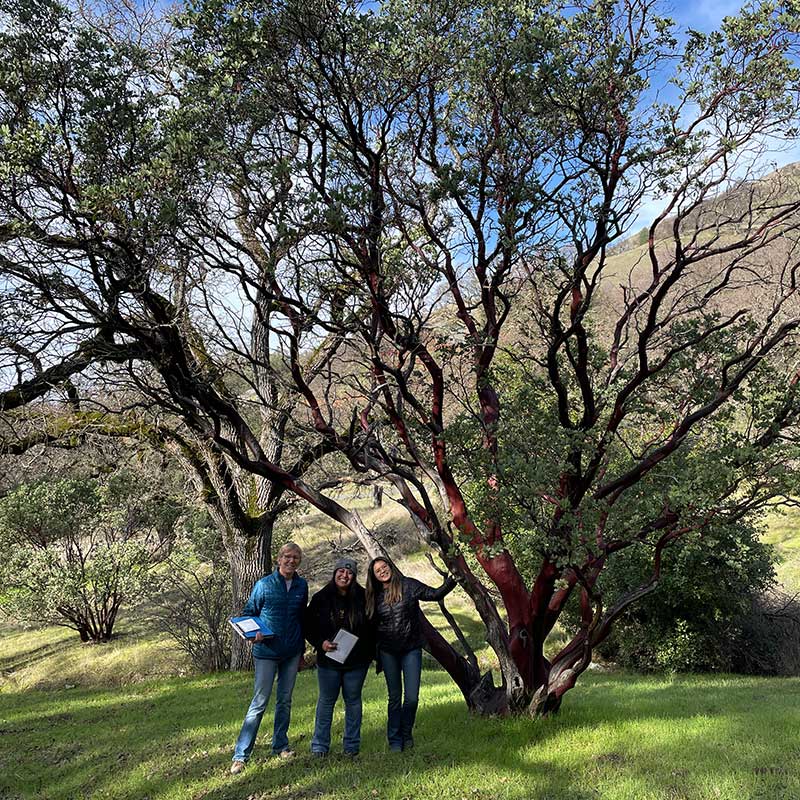
Erica Lundquist, NRCS Lakeport Field Office District Conservationist, alongside Forest Health Coordinator Estefania Laines and Senior Project Manager, Forest Health Nicole Lau attending a site visit.
Photo credit: Irenia Quitiquit

(Right) Forester Tom Bendure attending a site visit.
Photo credit: Wren Ward
Hazardous Roadside Fuels Reduction
LCRCD collaborates with county planners and contractors to reduce hazardous fuels along and hanging above critical evacuation routes throughout Lake County. These essential treatments lower flame lengths along important roadways and decrease the chance of burning material falling onto roads, ensuring public safety in the event of wildfire while providing clear ingress access for emergency response personnel.
Evacuation Route Clearing
With California Department of Forestry and Fire Protection (CAL FIRE) funding, LCRCD worked with local contractors throughout 2025 to reduce hazardous fuels along 6.85 miles of some of Lake County’s most critical evacuation routes: the Soda Bay Corridor near Kesleyville, Spruce Grove Road near Lower Lake, and numerous roadways in the northernmost portion of the County near Lake Pillsbury.
In 2026, LCRCD received funding from Pacific Gas & Electric (PG&E) to complete approximately five miles of evacuation route clearing along Spruce Grove Road between Lower Lake and Hidden Valley Lake.

Section of Forest Service Road 18N74, near Lake Pillsbury, prior to roadside vegetation clearance.
Photo credit: Ryan Wade

Section of Forest Service Road 18N74, near Lake Pillsbury, after roadside vegetation clearance.
Photo credit: Ryan Wade
Hazard Tree Removal
LCRCD is administering a $7M+ federal Community Wildfire Defense Grant (CWDG) in partnership with the Tribal EcoRestoration Alliance (TERA). Between now and 2029, in partnership with the County of Lake, LCRCD will identify and remove hazardous trees along critical evacuation routes while TERA carries out prescribed burning on 1,100 priority acres throughout Lake County. This funding will also support the Lake EcoCultural Cal-TREX led by TERA on an annual basis.
Interested in learning more?
Contact John Vandervort, Senior Program Manager, Forest Health
Landscape-Level Planning and Implementation
Mendocino National Forest Habitat Enhancement and Hazardous Fuels Reduction Project, Phase I
This project was developed in close collaboration with Mendocino National Forest Upper Lake Ranger District staff throughout late 2025 and early 2026 with funding support from the California State Coastal Conservancy. This project is located in the northernmost portion of Lake County and is designed to decrease wildfire risk, safeguard “green islands” not previously burned during the Mendocino Complex (2018) and August Complex (2020) wildfires, enhance northern spotted owl habitat, and protect communities along the west shore of Lake Pillsbury. LCRCD is currently seeking implementation funding for this project.
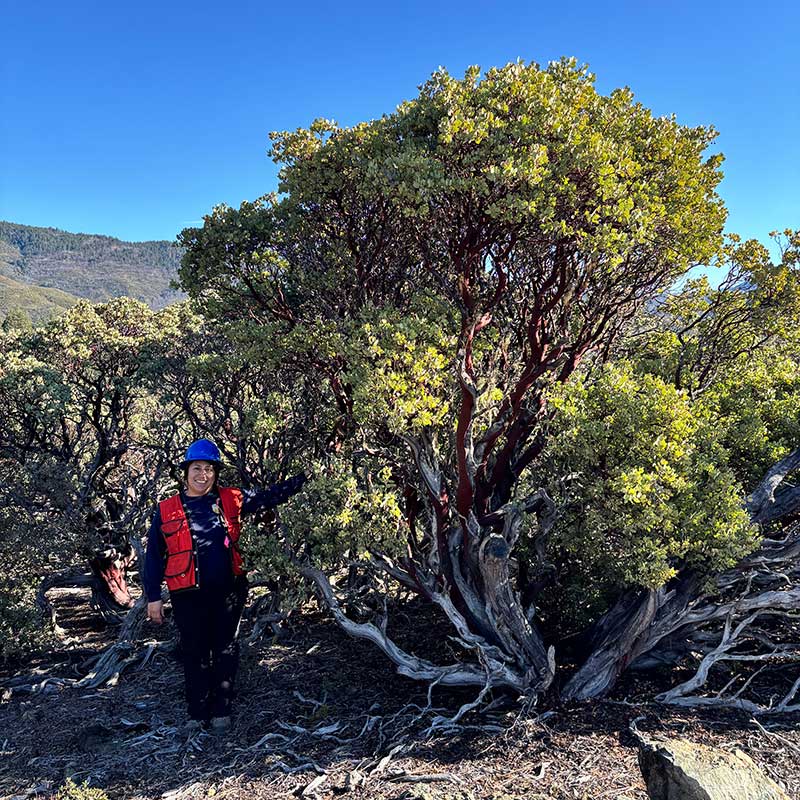
Forest Health Coordinator Estefania with a large manzanita.
Photo credit: Nicole Lau

Two young tule elk bulls in the Mendocino National Forest.
Photo credit: Nicole Lau
Lower Lake-Hidden Valley Hazardous Fuels Removal Project, Phase I
This project was developed in close collaboration with Estelle Clifton, Registered Professional Forester, between 2024-2026 with funding support from the California Department of Forestry and Fire Protection (CAL FIRE). This project is located in the Lower Lake area north of Hidden Valley Lake and includes the implementation of roadside shaded fuel breaks, thinning forest stands with high fuel loads, and site preparation for prescribed burning. LCRCD is currently seeking implementation funding for this project

Field data collection at Six Sigma Ranch and Winery in Lower Lake.
Photo credit: Nicole Lau
Interested in learning more?
Contact John Vandervort, Senior Program Manager, Forest Health